
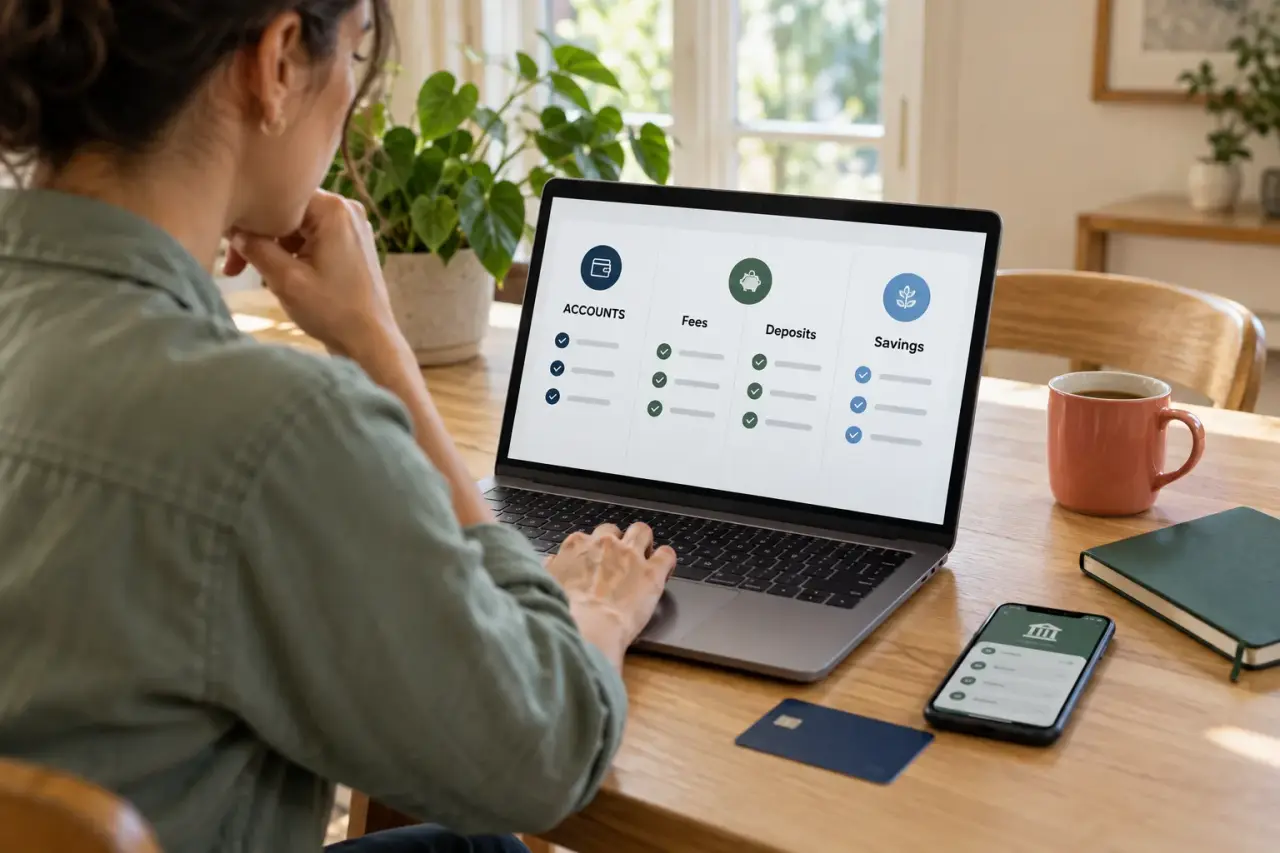
Your paycheck doesn't come from one place. Your bank account shouldn't assume it does.
If you drive, deliver, walk dogs, or juggle a few platforms, your money lands in batches — some days nothing, some days three deposits at once. A bank built for a 9-to-5 salary doesn't always handle that well. Before you open (or switch) an account in 2026, here's what to actually check.
Which banks offer early direct deposit for gig income?
Several banks now release your direct deposit as soon as they get notice from the payer, instead of waiting for the scheduled date. Chime, for example, advertises getting paid up to two days early with direct deposit, with no monthly maintenance fees or minimum balance requirements. Varo and SoFi offer a similar window. Varo says its accounts let you get paid up to two days early with direct deposit, with no monthly maintenance fees and no minimum balance requirements.
Some banks make this automatic rather than something you have to request. Ally states that early direct deposit is automatic for customers with recurring deposits, with no enrollment or special request needed.
For gig income specifically, this matters because platform payouts often post as direct deposits even though they're irregular — so the same "up to two days early" feature that helps a W-2 worker can help you too, deposit by deposit.
What does an overdraft actually cost you right now?
Here's something worth knowing: a federal rule that would have capped most bank overdraft fees at $5 was finalized in late 2024, but it never actually took effect. Keep the claim but add a source link or citation to the CFPB rule and the congressional action, so readers can verify it.
So as of 2026, there's no nationwide cap on what a bank can charge you for overdrafting — each bank sets its own policy. That makes it worth checking before you sign up, not after. Some accounts avoid the issue by building in a cushion: According to Chime, SpotMe overdraft protection covers overdrafts up to $200 with no fees, and eligibility requires at least $200 in direct deposits each month. Others, like Capital One, have taken a different route — Capital One describes its No-Fee Overdraft feature as not charging you if it approves a check, electronic payment, or recurring debit card payment that exceeds your balance.
If a bank doesn't advertise its overdraft policy clearly, that's a question worth asking before you deposit your first paycheck there.
Why no monthly fee and no minimum balance should be the baseline, not the upsell
Gig income swings. A bank that charges you $12 a month unless your balance stays above some threshold is a bad match for anyone whose balance moves with the schedule. The good news is this is now table stakes at most online-first accounts — SoFi Checking advertises no monthly fees or minimum balance, on top of early direct deposit.
Why does ATM access matter more than people think?
If you get paid out to a debit card and need cash for tips, tolls, or gas, fee-free ATM access adds up fast. Network size varies a lot between banks. Ally states it offers more than 75,000 fee-free ATMs, plus a $10 per cycle ATM fee reimbursement. Capital One and Chime both run large fee-free networks too, so it's worth checking which one actually has machines near your routes, not just a big number on a landing page.
If your income is 1099, does a business account solve a different problem?
Some gig and freelance workers eventually want more than a checking account — they want taxes set aside automatically and income tracked by client or platform. That's a different category of account. Found is built for tax planning, with no monthly fees, no minimum opening deposit, an automatic tax savings feature that calculates and sets aside estimated taxes, and integrations with Stripe, DoorDash, Uber, Etsy, and PayPal. That kind of account won't replace your everyday spending account, but it can sit alongside one if separating gig income from personal spending is the bigger headache.
A simple way to decide
Ask yourself three questions before you open anything:
Does it get my money to me as fast as it can, not as slow as it's allowed to? Early direct deposit, released the moment the payer sends notice.
What happens the one week I come up short? Know the actual overdraft policy — don't assume there's a federal $5 cap protecting you, because right now there isn't.
Does it cost me anything just to hold my own money? No monthly fee, no minimum balance, and ATM access where you actually drive or deliver.
None of this requires a perfect credit score or a steady W-2 — opening an account like this typically just takes a quick online application that doesn't require your credit score. The bank should adapt to your schedule. Not the other way around.
The right account isn't the one with the most features — it's the one that doesn't punish you for getting paid on gig time instead of corporate time.
Account terms, fees, and features mentioned here (Chime, Varo, SoFi, Ally, Capital One, Found) are set by those companies and can change. Check each provider's current terms before opening an account.
Account terms, fees, and features mentioned here (Chime, Varo, SoFi, Ally, Capital One, Found) are set by those companies and can change. Check each provider's current terms before opening an account.