
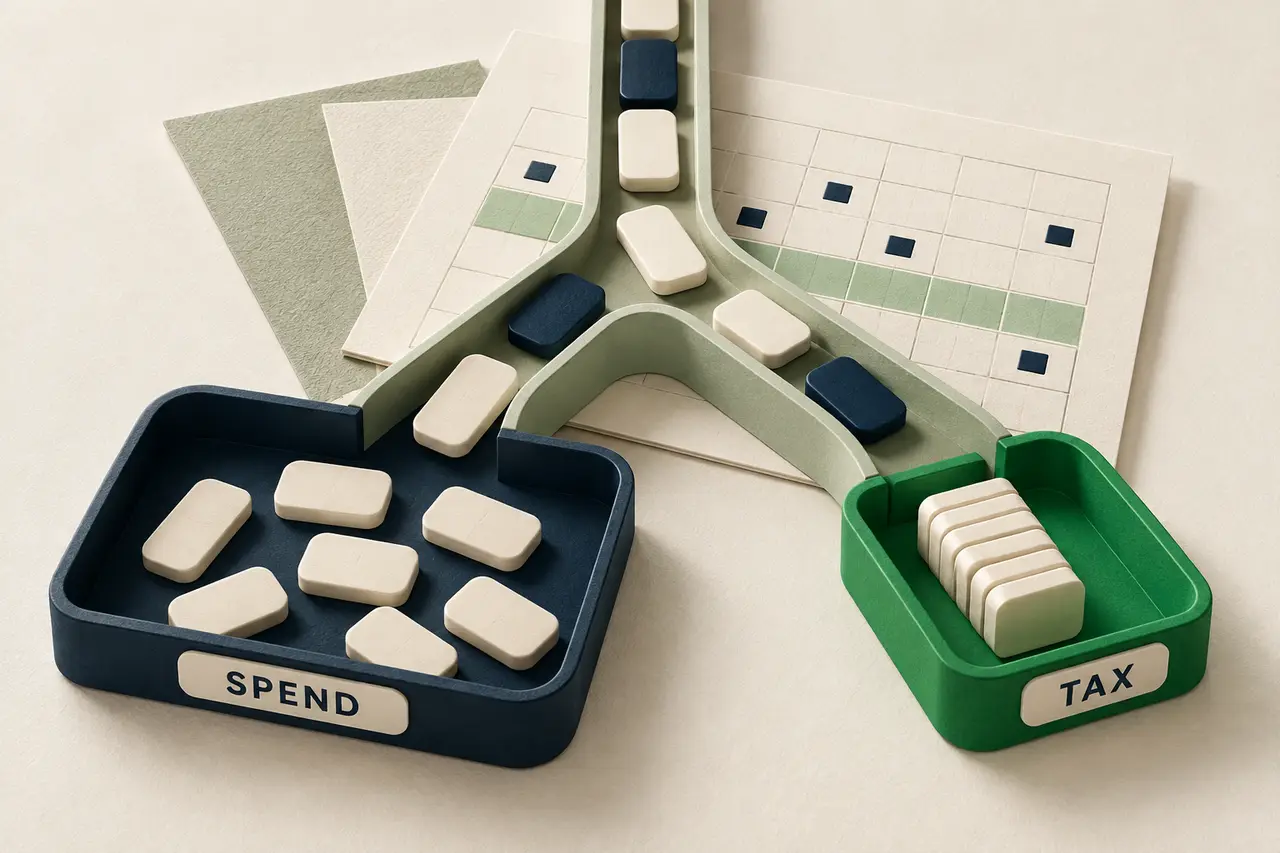
Why gig income feels bigger than it really is
When you get a W-2 paycheck, your employer automatically pulls out taxes before the money ever hits your account. When you drive for Uber, deliver for DoorDash, shop for Instacart, or pick up any other 1099 gig work, that doesn't happen. As an independent contractor, taxes are not taken out of your paycheck, and the responsibility falls on you to make sure you're setting enough aside to pay them.
That's why a $900 week can feel like a win on Friday and a problem next April. The whole amount lands in your account, but part of it already belongs to the IRS.
The two taxes you're actually paying
As a gig worker, you're considered self-employed by the IRS the moment you have net earnings from self-employment of $400 or more. That triggers two separate tax bills:
1. Self-employment tax. This covers Social Security and Medicare, the same payroll taxes a W-2 job withholds automatically. The self-employment tax rate consists of 12.4% for Social Security and 2.9% for Medicare taxes — 15.3% combined. Normally an employer pays half of this; as a gig worker, you're both the employee and the employer, so you cover the whole thing yourself.
2. Federal income tax. This is the regular tax based on your tax bracket, same as anyone else pays. How much depends on your total income, filing status, and deductions.
On top of that, if your state charges income tax, you'll owe a piece there too.
So what's the actual number?
There's no single percentage that's right for everyone, because it depends on your profit, write-offs, and state. But financial sites that specialize in self-employment taxes generally land in the same range: as a 1099 contractor, you're responsible for your own taxes, and a general rule is to set aside 25-35% of your income for federal, state, and self-employment taxes.
A few more data points that back this up:
Most financial experts recommend setting aside 25–30% of your net self-employment income for taxes, covering federal income tax and self-employment tax.
If you live in a high-income-tax state like California, New York, or Oregon, you may want to budget 35–40%.
In general, the recommendation is to set aside 25-30% of 1099 income for taxes.
If you want one rule of thumb to use when you're not ready to do a full calculation: start at 25%, and nudge it up if you live in a high-tax state or expect to clear a decent profit after expenses.
Why mileage and expenses change the math
The self-employment tax and income tax apply to your profit, not your total earnings. That means every legitimate business expense — gas, phone bill, a share of your car payment, supplies — lowers the amount you actually owe tax on.
Mileage is usually the biggest one for delivery and rideshare drivers. Tracking your business miles carefully can shrink your taxable profit by a lot, which is part of why some gig workers end up safely setting aside less than the standard 25-30% once they've accounted for real deductions. (We've written separately about how to track mileage the right way and the difference between the standard mileage rate and deducting actual expenses — worth a read if you drive a lot.)
The safest approach if you're not sure: set aside the higher percentage, and treat anything left over at tax time as a pleasant surprise rather than coming up short.
Quarterly payments, not just an April bill
Here's the part that catches a lot of gig workers off guard: you're not supposed to wait until April to pay what you owe. The IRS runs on a pay-as-you-go system, and individuals, including sole proprietors, must make estimated tax payments if they expect to owe tax of $1,000 or more when their return is filed.
For most full- or part-time gig workers, that threshold is easy to cross. If you pay quarterly estimated taxes, payments are due on April 15, 2026; June 15, 2026; September 15, 2026; and January 15, 2027.
Missing a quarter doesn't just delay the bill — it can mean a penalty. The IRS uses a pay-as-you-go income tax system, meaning you must pay your taxes as you earn income, and it enforces this by charging penalties for underpayment if you haven't paid enough through withholding or quarterly payments.
A simple way to do this without a spreadsheet
You don't need to be a bookkeeper to stay on top of this. The habit that actually works for most gig workers is boring but effective:
Every time a gig payout lands, immediately move a percentage — say, 25% to 30% — into a separate account you don't touch.
Don't wait until tax season to check the math. Look at your running total every month so there are no surprises.
When a quarterly deadline rolls around, pay from that separate pile, not from your regular spending money.
If your income jumps (a great month, a new gig app, more hours), raise your set-aside percentage for that chunk of money until you confirm it wasn't a fluke.
A separate account matters more than people think. If the tax money sits in the same account as your grocery and gas budget, it tends to disappear. Keeping it physically separate — even in a basic second checking or savings account — removes the temptation entirely.
The bottom line
There's no perfect number that fits every gig worker, but 25% to 30% of your net gig income is a reasonable starting point for most people, with adjustments up for high-tax states or down once real business deductions are factored in. The bigger win isn't finding the exact right percentage — it's building the habit of setting money aside the moment it arrives, instead of trying to find it all at once in April.