
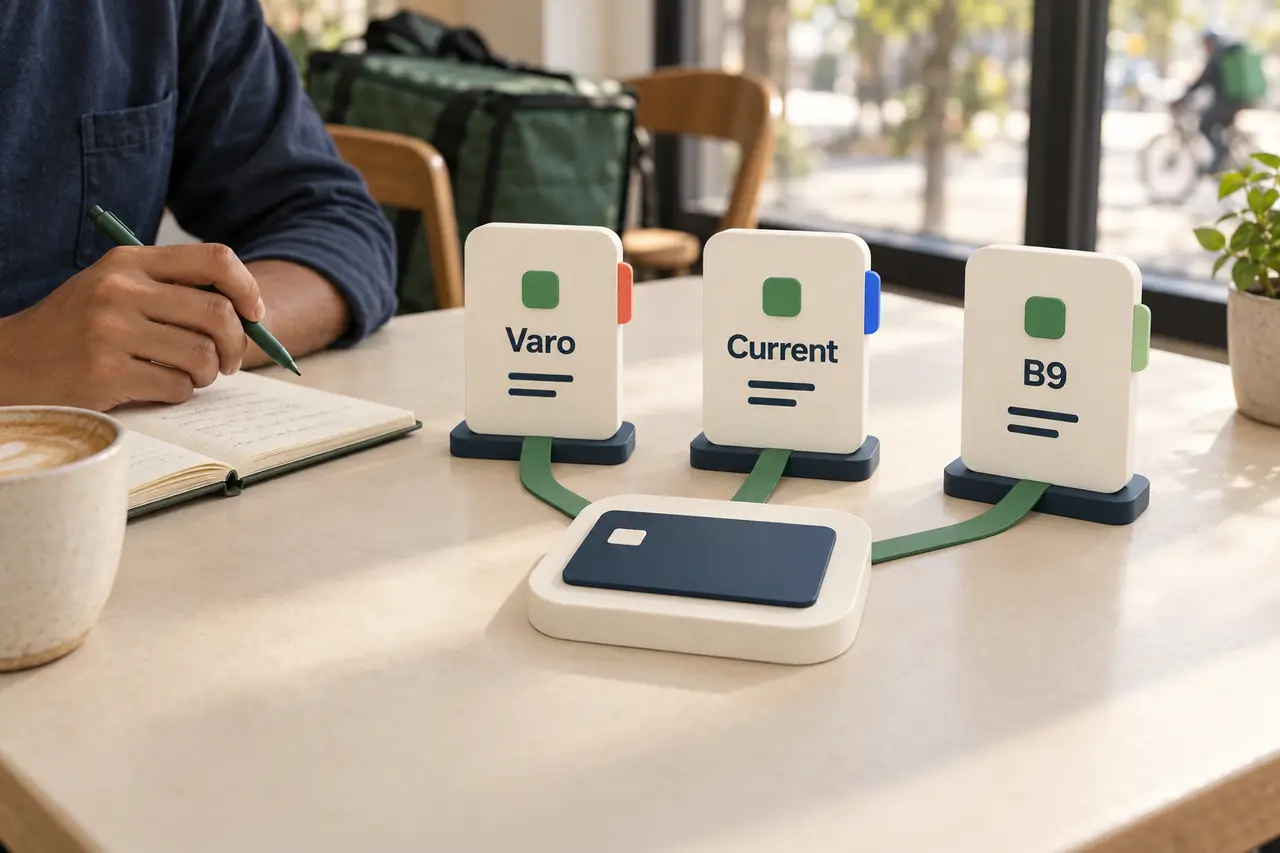
If you drive for Uber, deliver for DoorDash, or just get paid on a schedule that doesn't match your bills, your bank account has to work harder than the one your parents used. You need fast access to deposits, no surprise fees, and ideally some help getting through the gap between gigs. Varo, Current, and B9 all pitch themselves as answers to that problem. They're not the same tool, though, so here's what each one actually does.
Varo: a real bank with strong savings tools
Varo stands out because it isn't just an app sitting on top of someone else's bank — it holds its own national bank charter. Varo Bank is a mobile-only bank offering no hidden fees and full FDIC insurance up to $250,000, and it was the first fintech to receive a U.S. national bank charter, meaning it is a fully licensed bank that holds and insures your deposits directly. That matters a little for peace of mind, even if the day-to-day experience looks similar to other apps.
On fees, Varo keeps things simple. Varo does not charge a monthly fee, minimum balance fee, or overdraft fee on the bank account. You do pay something if you step outside its network: out-of-network ATM withdrawals carry a $3.50 fee, and a third-party ATM owner may add their own charge.
Where Varo really separates itself is savings. As of July 2026, Varo pays 3.75% APY on the first $5,000 in your savings account, then drops to 1.00% APY on any balance above $5,000. To get the higher rate, you'll need $1,000+ in qualifying direct deposits and a positive balance. For gig workers who can route earnings through direct deposit, that's a meaningfully better rate than a typical savings account.
Varo also offers a small-dollar advance tool. There's no interest, but Varo charges a mandatory flat fee that scales with the advance amount, typically from $1.60 up to $40.
Current: built around overdraft cushion and a bigger advance
Current leans hardest into the "never get hit with an overdraft fee" pitch. Current Banking's pitch is no monthly fee, no minimum balance, fee-free overdraft up to $200, direct deposits up to two business days early, and up to 4.00% APY on savings.
The overdraft cushion isn't automatic on day one — it's fee-free overdraft up to $200 for qualifying members, which generally means you need qualifying direct deposits flowing in first. Current's paycheck advance is also bigger on paper than most competitors: Paycheck Advance up to $750, depending on your deposit history.
Cash deposits and ATMs work about like Varo's setup. Current accepts cash deposits at participating retailers like Walmart, 7-Eleven, and Family Dollar, and gives access to 40,000+ free ATMs via the Allpoint network.
The trade-off with Current, same as Varo, is that it's fully app-based. There are no physical branches, and customer service is via chat and phone through the app. If you ever want to talk to a person across a counter, neither of these apps will give you that.
B9: built around getting paid before payday
B9 takes a different angle. Instead of leading with a savings rate, it leads with getting you cash before your next deposit actually lands. The app offers everyday banking through a B9 Visa Debit Card alongside cash advances, structured around paycheck history rather than a credit check. According to B9's own app listing, advances grow as your deposit history builds — first-time members may qualify for an advance range from $10-50, with many members advancing up to $150-$250 after their third paycheck, and eligible members can cash out their full available advance amount at once instead of facing forced daily limits.
B9 runs on a membership model rather than charging per-transaction overdraft or advance fees, with monthly membership pricing disclosed in the app rather than a single flat rate across all plans. Along with advance access, the B9 Visa Debit Card offers cashback on everyday spending, and the app includes tools like instant transfers to other apps. For gig workers whose main pain point is the wait between finishing a shift and actually seeing money, that structure is the point — it's built around your paycheck pattern, not a credit file.
Which one actually fits a gig worker's life
If you want a real bank with the strongest savings APY and don't mind routing a steady direct deposit through it, Varo's combination of FDIC backing, no fees, and tiered savings rate is hard to beat.
If overdraft anxiety is your main problem and you want the biggest built-in paycheck advance, Current's $200 fee-free overdraft and up-to-$750 advance give you the biggest cushion.
If your real issue is the gap between finishing work and getting paid, and you want advance access that grows with your deposit history rather than a credit check, B9's model is built specifically around that rhythm, with cashback layered on top for everyday spending.
None of these are payday loans, and none of them should be treated as a long-term fix for a budget that doesn't balance. They're tools to smooth out timing — the real work is still building a cushion so you need them less over time.
Want to see how B9's advance limits and cashback work for your own paycheck pattern? You can check your numbers directly in the app before you commit to anything.