
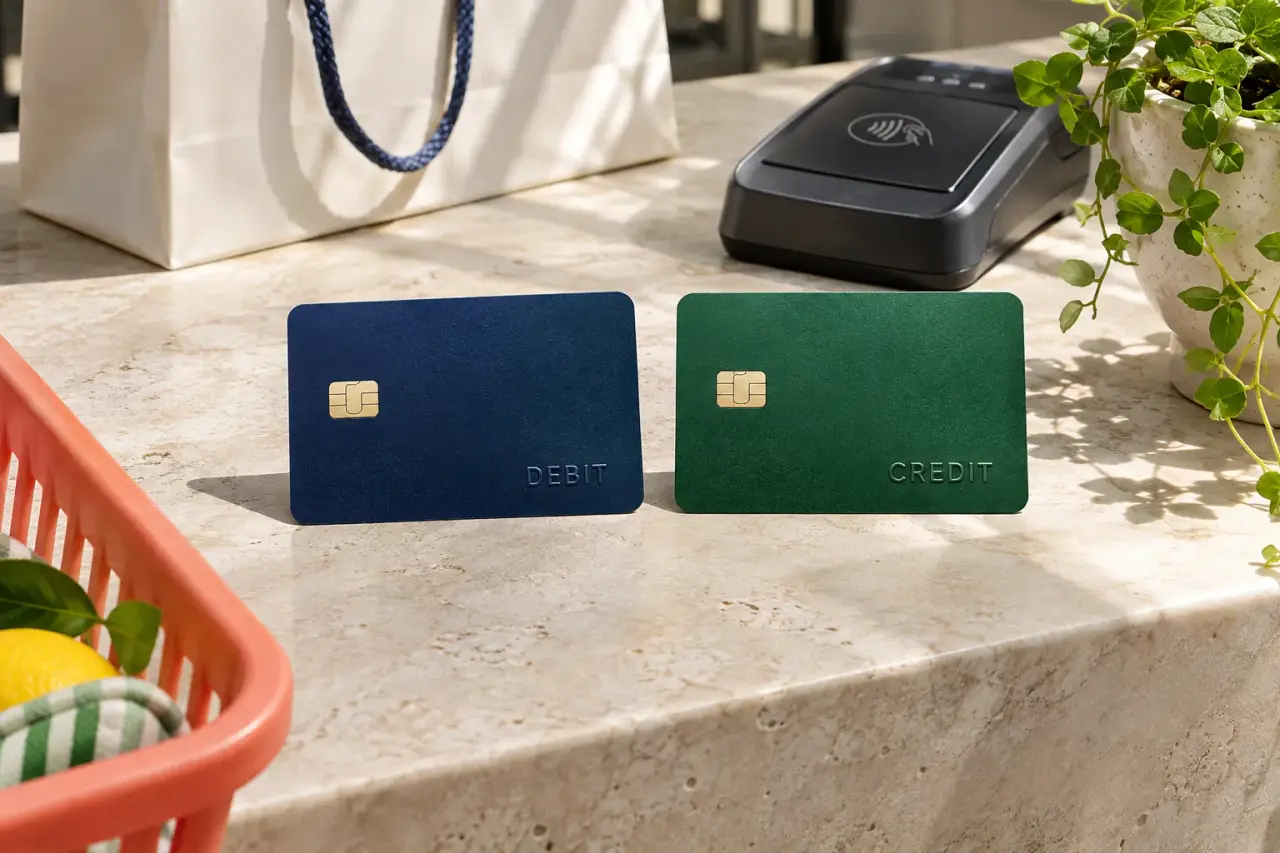
The short answer
Credit cards almost always advertise higher cashback rates than debit cards. That's not a coincidence — it comes down to a federal rule most people have never heard of. But "higher rate" doesn't automatically mean "more money in your pocket," especially if you ever carry a balance.
Here's how the two actually compare, and when each one makes sense.
Why credit cards pay more cashback
Every time you swipe a card, the store pays a small fee to the bank that issued it. That fee is called an interchange fee, and it's where cashback money comes from.
Credit card interchange fees are typically higher and usually a percentage of the transaction, with the average U.S. credit card interchange fee reported to be close to 2% of the transaction, according to industry data. Debit cards are a different story. For issuers with $10 billion or more in assets, debit card interchange fees are capped at $0.21 plus 0.05% of the transaction value, plus $0.01 for fraud-prevention costs, per Federal Reserve Regulation II, per Federal Reserve Regulation II. That cap comes from the Durbin Amendment, a 2010 banking law.
This regulatory asymmetry explains why credit card rewards are far more generous than debit card rewards at large institutions: credit interchange funds rewards, while the Durbin-capped debit interchange at large banks cannot support comparable rewards programs. That's why a typical rewards credit card might advertise 1.5% to 5% back, while a big-bank debit card tops out much lower.
Why some debit cards still offer cashback
There's one important exception. The $10 billion cap only applies to large banks. A carve-out for institutions under $10 billion in assets is the reason credit unions and smaller banks still offer cashback debit today. That's why some debit cards, especially from smaller banks and fintech apps, can still offer competitive cashback rates even though the big national banks mostly dropped the feature years ago.
What each card actually pays
On the credit card side, competition among credit cards is fierce, with cards that give 2% or more cash back on purchases, plus bonus perks like purchase protection or extended warranties — for example, No change needed..
On the debit side, rewards are usually smaller and more limited. Debit rewards are typically smaller than credit card rewards, because large banks face caps on debit interchange fees, which means there's often less money available to fund rewards — that's why many rewards debit cards have limits, categories, or eligibility rules.
The part that changes everything: interest
A higher cashback rate on a credit card only helps if you pay the bill in full. If you carry a balance, interest can erase the reward many times over.
For all credit cards, the average APR in Q3 2026 was reported at 21.19%, and for cards accruing interest, 22.36%, according to Federal Reserve data. That's a steep number to run against a 2% reward.
How the math plays out in practice
Think of it this way: a $20 cashback reward on $1,000 of spending doesn't mean much if letting that $1,000 sit on the card for a few months at today's rates costs you far more in interest than you earned back. For example, imagine you pay $50 in interest to earn $20 in rewards — you've lost $30 overall. Compare that to a debit card where you earn $10 in rewards with $0 interest — you're ahead by $10. These are illustrative numbers, not a guarantee of what any specific card charges or pays; always check your own card's terms.
That's the trade-off in one sentence: credit cards can pay more, but only to people who pay their statement in full every single cycle. For anyone who might carry a balance even occasionally, a debit card's smaller, guaranteed reward can end up being the better deal.
Other real differences besides the rate
Spending source. A debit card pays out of money that's already in your checking account. A credit card is a loan you pay back later — so credit card rewards are always "borrowed" in a sense until you pay the bill.
Credit impact. Debit card spending doesn't build credit history or affect your credit score, since there's no borrowing involved. A credit card, used responsibly, can help build credit over time — but missed or late payments can also hurt it.
Approval. Credit cards involve a credit check and approval decision. Debit cards tied to a checking account generally don't, which matters if your income is irregular or you're still building credit.
Caps and categories. Both card types often cap how much spending actually earns the advertised rate, so the sticker rate isn't always what you'll earn on everything you buy.
Which one makes sense for you
If you reliably pay your credit card balance in full every month, a cashback credit card will usually out-earn a debit card on the same spending. If there's any chance you'll carry a balance — even once in a while, which happens to a lot of people when a paycheck is late or an expense comes up — a debit card's guaranteed, interest-free reward is often harder to beat, even at a lower rate. If a late paycheck is the usual trigger, some people bridge the gap with cash advance apps instead of leaning on a credit card.
For gig and hourly workers whose income can swing week to week, that second point matters more than the advertised percentage. A debit card attached to your everyday checking account also means the cashback shows up as part of money you can already spend, with no bill coming due later.
Neither card type is "better" across the board. The right one depends on whether you're earning rewards on money you already have, or on money you're promising to pay back later — and how confident you are that you'll pay it back on time, every time.
This article is for general information and doesn't cover every card's terms. Check your own card's rewards program, fees and APR before deciding.
This article is for general information and doesn't cover every card's terms. Check your own card's rewards program, fees and APR before deciding.