
The difference that actually matters
If you're on SSI, you already know the drill: let your bank balance creep over $2,000 and your payment can stop. If you're on SSDI, that rule simply doesn't apply to you.
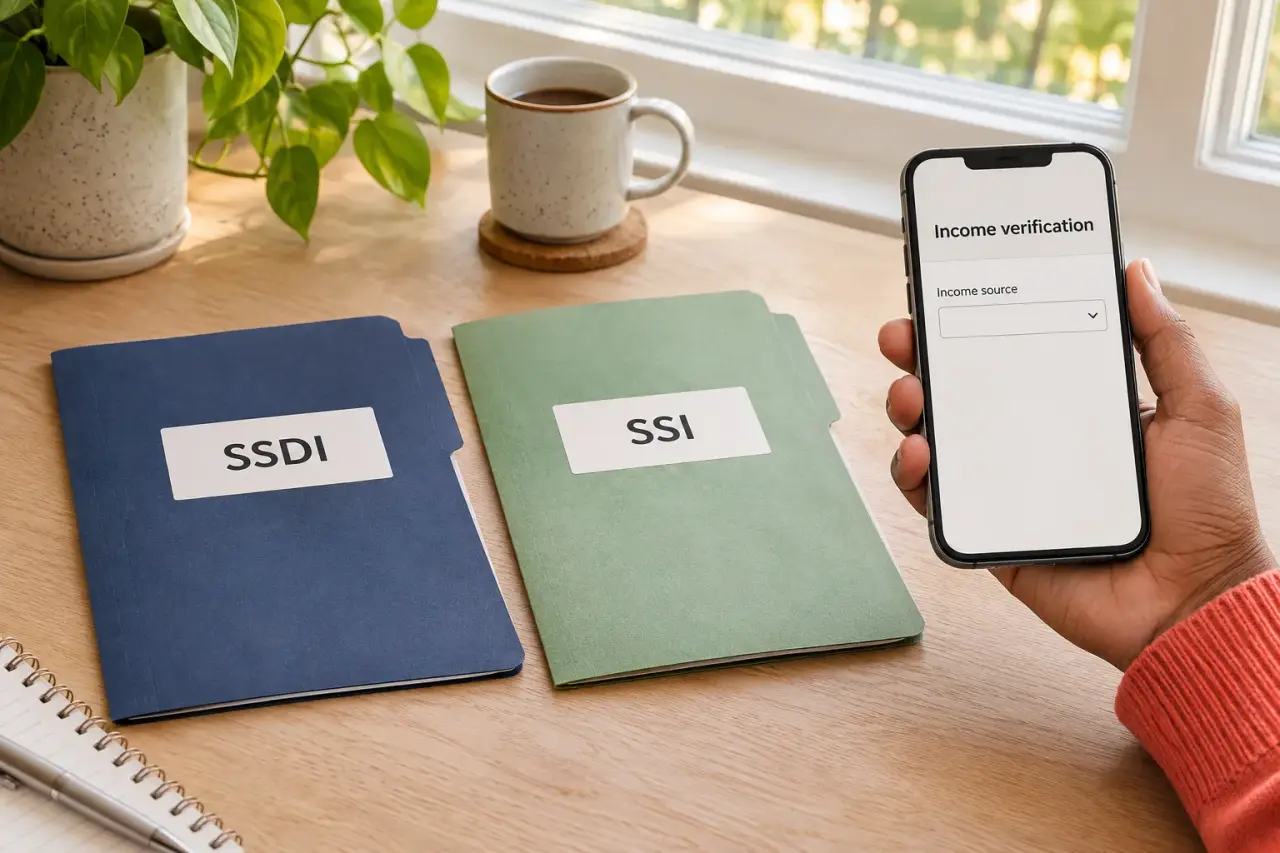
SSDI (Social Security Disability Insurance) has no asset or resource limit at all. You can have money in savings, a paid-off car, an investment account, or a cash advance sitting in your checking account, and none of it touches your SSDI eligibility. SSI (Supplemental Security Income) works the opposite way. It's a needs-based program. To qualify for SSI, you can't have more than $2,000 in countable resources if you're single, or $3,000 if you're a couple. Go over that line on the wrong day and SSI can suspend the payment for that month.
That's the single most useful fact if you're deciding whether to take a cash advance while on disability income. On SSI, you have to think about where the advance money sits and for how long. On SSDI, you don't.
Why doesn't SSDI have an asset limit?
SSDI is an earned benefit — you paid into it through payroll taxes while you worked, the same way Social Security retirement works. SSI is funded differently and exists to top up income for people with very limited means, so it comes with the strict resource test SSDI never had. That's also why if you receive both SSDI and SSI at once — called concurrent benefits — the resource limit still applies, but only because of the SSI portion. The SSDI side of a concurrent check is still asset-limit-free; it's the SSI piece that keeps you under $2,000.
How much does SSDI pay in 2026?
There's no flat SSDI amount the way there is with SSI, because SSDI is based on your own earnings history. In 2026, the average SSDI payment is $1,634.70 a month and the maximum is $4,152 a month. SSI pays a federal maximum of $994 a month for an individual and $1,491 for a couple. Most people land well below the SSDI maximum — fewer than one in a hundred disabled workers receives anything close to $4,152, since reaching it takes decades of top-tier earnings.
What is the only income test SSDI has?
SSDI isn't completely hands-off about money — it just measures a different thing. Instead of watching your savings, it watches whether you're working. The SGA amount for persons with disabilities other than blindness is $1,690 per month in 2026. For persons who are blind, the amount of earnings that indicate SGA is $2,830 per month in 2026. This is called Substantial Gainful Activity, or SGA, and it only looks at what you earn from actual work.
A cash advance isn't earnings from work. Neither is a bank balance, a gift, an inheritance, or interest on savings. SGA is strictly about paid labor, so none of that non-work money can push you over the line the way a paycheck could.
When does your SSDI or SSI deposit actually land?
Cash advance apps generally want to see a recent, recurring deposit before they'll approve anything — so the day your benefit hits your account matters. SSDI and SSI run on two different calendars.
SSDI only — paid on a Wednesday, and which Wednesday depends on your birthdate. Birth date between the 1st and the 10th: paid on the second Wednesday of each month. Birth date between the 11th and the 20th: paid on the third Wednesday. Birth date between the 21st and the 31st: paid on the fourth Wednesday.
SSI only — payments are generally issued on the first day of each month.
Both SSDI and SSI (concurrent benefits) — SSI is on the 1st and your SSDI is deposited on the 3rd of each month.
Started benefits before May 1997 — your Social Security payment typically arrives on the third day of each month, regardless of your birth date.
If a cash advance app is asking "when did your last deposit land," knowing which of these four patterns applies to you helps. It tells you exactly what to expect, and when to check your balance before you apply.
Do cash advance apps treat SSDI differently from other income?
Most cash advance apps don't ask what kind of income you have. They look at the deposit itself: is it recurring, is it from the same source, has it shown up enough times to count. A Social Security deposit, whether it's SSDI or SSI, usually reads the same way to these systems as a paycheck does. Brigit's own eligibility language, for example, requires at least three recurring deposits from the same employer or deposit source, without carving out SSDI as different from any other direct deposit.
B9 works the same way. It looks for at least $100 in payroll or benefit deposits into the account in the last 14 days, plus an eligible repayment history, before it will consider an advance. It doesn't matter whether the deposit came from a job or from SSDI. None of this is a guarantee. Every app's approval, and the size of what you're offered, depends on your actual deposit history and the provider's own terms. New users typically start small, between $10 and $50, with the amount growing as deposits keep landing consistently.
The bottom line
If you're on SSDI only, you don't need to manage your bank balance the way an SSI recipient does — there's no number to stay under. What you do need to watch is the SGA earnings test, if you're working. You also need to know the payment date that matches your situation. That tells you when the deposit that makes you eligible for an advance is actually going to show up.
For a side-by-side on how SSI recipients should think about advances — including the $2,000/$3,000 balance issue in more depth — see B9's guide to cash advance apps for SSI recipients.