
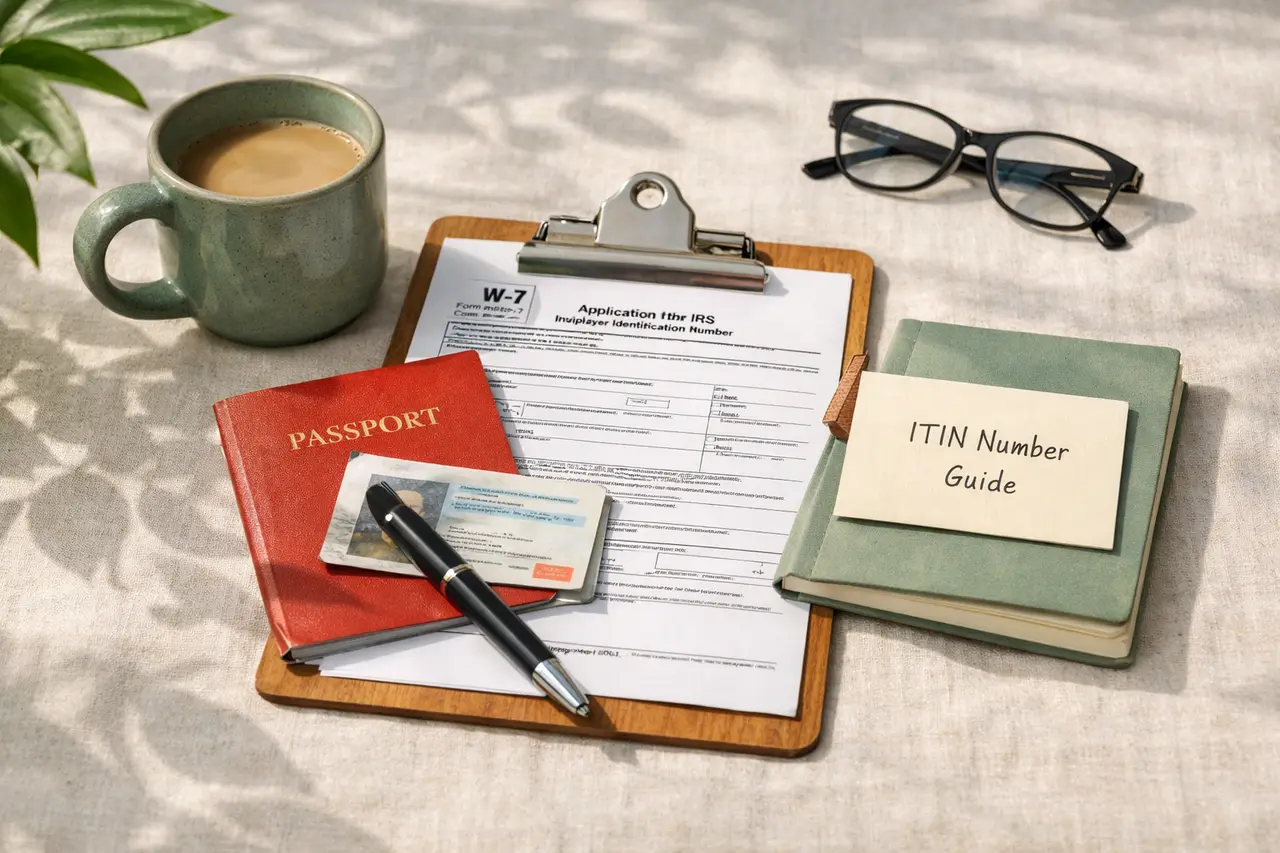
If you work or file taxes in the U.S. but don't qualify for a Social Security Number, you'll likely need an Individual Taxpayer Identification Number (ITIN) instead. Getting one means filling out IRS Form W-7. It's not complicated, but a few steps trip people up — so here's the process laid out plainly.
Who actually needs an ITIN
The IRS is specific about this. You need an ITIN if you have a federal tax purpose and you're not eligible for an SSN. That includes situations where you're legally required to file a U.S. federal income tax return, want to claim a refund or tax benefit, or can be claimed as a spouse or dependent for an allowable tax benefit. If you're a resident alien, nonresident alien, or their spouse or dependent, you can apply for an ITIN regardless of immigration status.
An ITIN won't change your immigration status and it doesn't give you permission to work — having one does not change a person's residency or immigration status and does not mean someone is eligible to work in the United States. It's strictly a tax number.
What you need before you start
Every ITIN application has the same core pieces:
1. A completed Form W-7
Complete Form W-7, Application for Individual Taxpayer Identification Number. If you're applying for more than one person in your household, each person applying for an ITIN must have a completed Form W-7.
2. A federal tax return, in most cases
In most cases, you must attach a completed federal tax return to Form W-7. The IRS won't process your ITIN application unless there is a valid tax filing reason. If you qualify for one of the narrow exceptions (certain treaty situations, for example), you can skip the return — but check the W-7 instructions carefully before assuming you qualify.
3. Identity and foreign-status documents
This is where most delays happen. The IRS accepts 13 documents. A valid (unexpired) passport is the only stand-alone document to prove both identity and foreign status. If you don't have a passport, you'll need to combine two other approved documents instead.
Those documents have to be originals or properly certified. Supporting Identification Documentation must be original, or certified copies from the issuing agency. Photocopies you make yourself, or documents with an apostille, won't be accepted.
Step-by-step: filling out and submitting Form W-7
Step 1 — Fill in Section 1. This covers your legal name (exactly as it appears on your ID), mailing address, date and place of birth, and country of citizenship. Form W-7 asks for the reason the applicant needs an ITIN, the applicant's name, mailing address and, if different, foreign address, the applicant's birth date and location of birth, the country where the applicant is a citizen, the applicant's foreign tax ID number, if they have one, the applicant's U.S. visa number, if applicable, and details about documents being submitted to verify the applicant's identity.
Step 2 — Check one reason box. The form lists several reasons for applying (filing a return yourself, being claimed as a dependent, etc.). Pick the one that matches your situation.
Step 3 — Sign it. An unsigned form gets sent right back. For a child under 18, a parent generally signs on their behalf.
Step 4 — Attach your tax return and documents. If your spouse or dependents are ITIN applicants, attach Forms W-7 for each applicant to the front of the tax return. Leave the SSN field blank for anyone applying for an ITIN — leave the area for SSN blank for each ITIN applicant listed on the tax return; the IRS will write in the assigned ITINs and forward the tax return for processing.
Where and how do you submit Form W-7?
Step 5 — Choose how to submit. You have a few options:
Mail it. Send the W-7, your return, and your documents to the IRS ITIN Operation in Austin, Texas. If you mail original documents, the IRS will send them back — the IRS returns original documents within 60 days of receiving your application.
Go in person. You can apply at an IRS Taxpayer Assistance Center that offers ITIN services, or at a Volunteer Income Tax Assistance (VITA) site with ITIN services, where staff can review your documents on the spot.
Use an Acceptance Agent. An Acceptance Agent can help complete and submit Form W-7, review and mail supporting documents, and mail your ITIN application package to the IRS for processing. A Certifying Acceptance Agent (CAA) goes a step further and can authenticate certain documents so you don't have to part with your original passport at all.
There's no fee from the IRS for any of this — Form W-7 itself is free to file. Acceptance Agents may charge for their help, but the government side of the process costs nothing.
How long does ITIN processing take?
Allow 7 weeks for the IRS to notify you about your ITIN application status. It can take 9-11 weeks if it's tax season (January 15 to April 30) or if you applied from overseas. There's no official way to expedite it, so if you're applying ahead of a filing deadline, give yourself a wide cushion.
A few things to double-check before you mail anything
Don't send originals you can't live without. If you need your passport back quickly for travel or work, consider a Taxpayer Assistance Center or Certifying Acceptance Agent instead of mailing the original.
An ITIN doesn't open every door. It lets you file taxes and claim certain benefits tied to a return, but it's not a substitute for an SSN everywhere — some credits and programs require an SSN specifically.
Mark the renewal box if this isn't your first ITIN. To renew an expired ITIN, fill out the sections to complete Form W-7 for a renewal. You don't need a new number — the same one gets reactivated once the renewal is processed.
Once your ITIN arrives, it's yours to use on future tax returns, bank paperwork, and other situations that ask for a federal tax ID when an SSN isn't an option. If you're waiting on your ITIN and wondering what you can and can't do with your money in the meantime, B9 has more guides on banking and cash advance options that work for ITIN holders.